
Ossuccio, a beautiful village on Lake Como

Among the many beautiful things to see on Lake Como are the villages, and among the many villages to visit, one not to be missed is certainly Ossuccio.
The village of Ossuccio, located in one of the most picturesque spots on Lake Como (the Zoca de l’Oli), is a hamlet that has existed since before the Roman era. A long history, in part still traceable in the stones of its many churches, in the archaeological remains of the island it faces, and in its oldest hamlets.

Hi, I’m Marta, Local Blogger of Lake Como. Need help planning your lake itinerary? Check out my Travel Designer service!
To visit it is to discover, at once, treasures of historical, artistic, religious, as well as naturalistic interest. And excuse me if it is little!
What it perhaps lacks is a center, a square, a middle point. But this is a forgivable flaw, considering what it has to offer anyway.
In order not to miss anything, one must explore it from end to end.
The oldest hamlet? The one halfway up the coast and which gives the village its name.
And the most characteristic? For me there are a couple, Spurano and Ospedaletto, two lakeside hamlets, a tangle of fishermen’s cottages and stately villas.
What to see in Ossuccio on Lake Como
The list you are about to read below is also meant to suggest a hypothetical itinerary for you to follow, ranging from the lake side of the village up into the mountains.
Depending on how much time you have and how much you want to walk, you can decide how far to go in your exploration.
1# The Church of St. Mary Magdalene

Church of St. Mary Magdalene
Keeping this as a starting point can be convenient because of the presence of parking lots nearby.
Ossuccio, considering all its hamlets, has as many as 8 churches!
This one, in Romanesque style, dates back to the 11th-12th centuries, and its bell tower, in Gothic style and dating instead from the 14th-15th centuries, is one of the most photographed subjects on Lake Como.
The church is also a true artistic gem, decorated on the outside with hanging arches around its perimeter, and embellished inside with a scagliola altar, and several traces of frescoes, including a Madonna and Child.
You may find it closed, but it often hosts exhibitions, so if you’re lucky you’ll be able to see its interior as well.
2# The Comacina Island
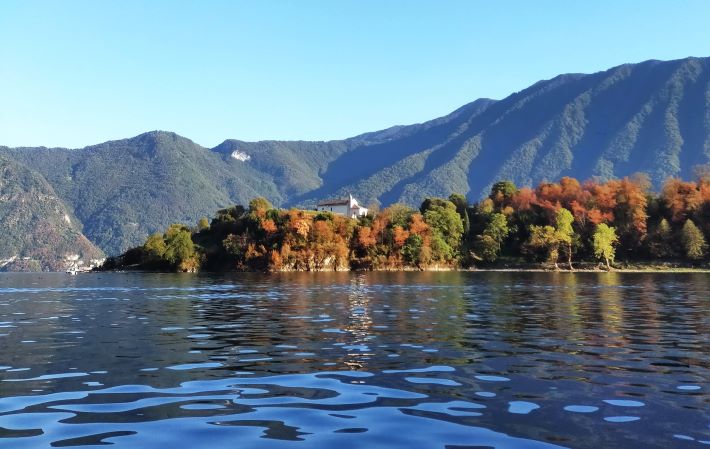
The Comacina Island
Just below the Church of S. M. Maddalena is one of the two piers (the other is in the village of Sala Comacina) from which you can take the ferry to reach Comacina Island. To visit it you need an entrance ticket to be made at the Antiquarium Museum or on the island itself.
It is the only island on Lake Como and is considered one of the most important archaeological sites in northern Italy, even called by some the “medieval Larian Pompeii.”
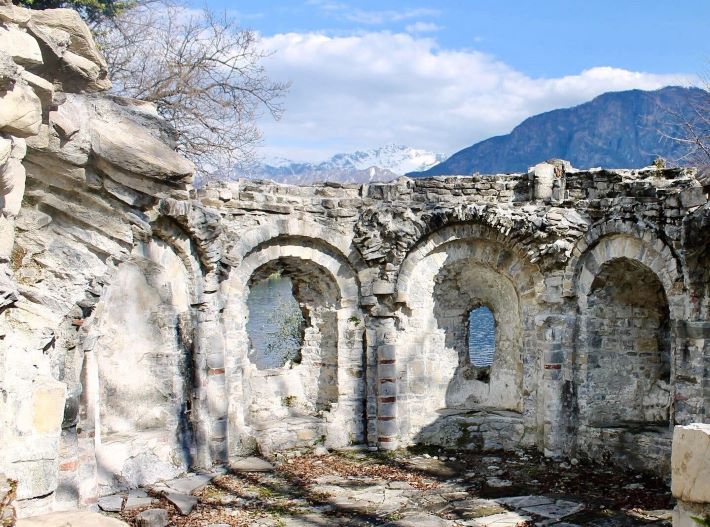
Ancient ruins on Isola Comacina
Visiting it means taking a walk among nature and extraordinary archaeological finds! And if you go there in the summer, don’t underestimate the possibility of also taking a nice swim from one of its small and wild (and therefore quiet) beaches.
Of the many churches of its past only one is still standing, the Church of St. John, dating back to the 16th century. It is to this saint that is linked the famous Festival of St. John, at the end of June, a very heartfelt and unmissable event if you are in the area at that time.
3# Church of St. James
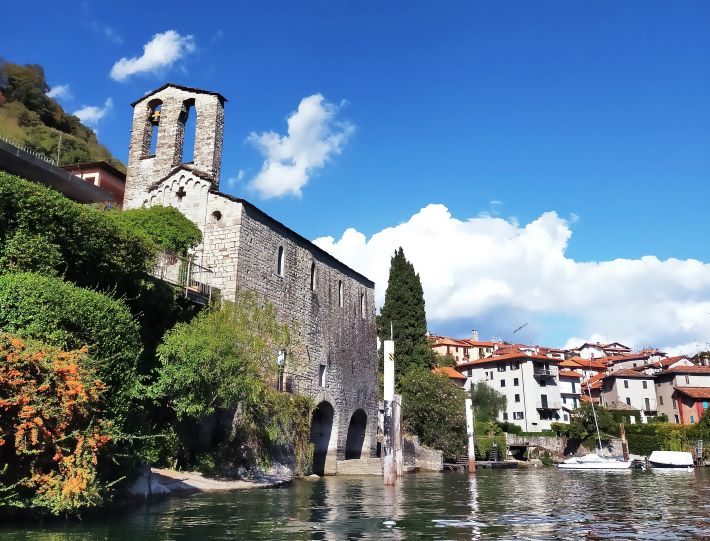
St. James as seen from the lake
Back on the ground and thus to the starting point, one can continue the walk.
I simply adore this church!
I love it because it is tiny, I love it because it is set in one of the most distinctive corners of the lake, and I love it because I have seen it for years from my bedroom window.
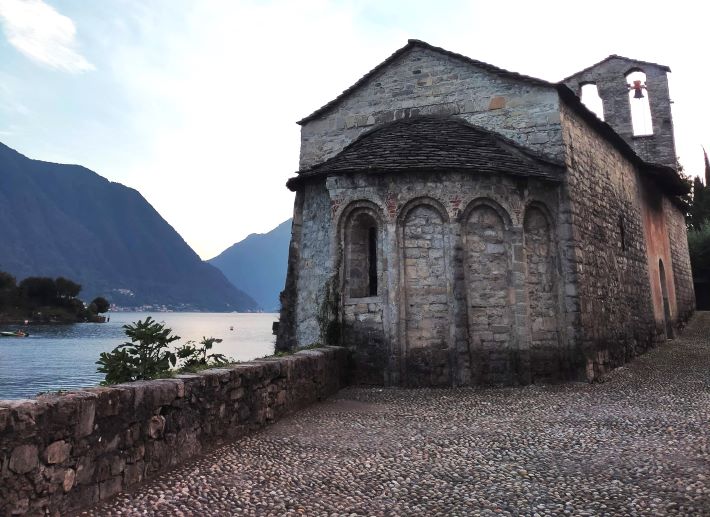
St. James Church
It, too, is Romanesque in style, and it, too, is unmistakable because of its bell tower, in this case sail-shaped, which is impossible not to recognize as soon as you reach the gates of the village, coming from Como.
But this little church has more tricks up its sleeve to pull off! Besides being literally overlooking the lake, it boasts numerous traces of frescoes both inside and outside, among which the giant figure of St. Christopher stands out. Also beautiful are the cross-shaped rose window above the doorway and the small stoup to the right of the entrance.
All in a tiny church.
4# Church of St. Agatha
To reach it, the best thing is to walk along the Via del Santuario, a cobbled lane that climbs from the Church of St. James toward the upper hamlets of the village.
The interesting thing that guards this other artistic jewel is a Roman votive altar on which can be distinguished the inscription Ausuciates, the toponym of the inhabitants of the Roman settlement from which the name Ossuccio is taken.
Here in short we go to the origins…centuries of history engraved in a stone!
5# Sacred Mount of Ossuccio and Sanctuary of the Blessed Virgin
It goes up again and to get there from the Church of Sant’Agata you have to calculate about 25-30 minutes of walking. A very pleasant walk considering the context in which you are immersed!
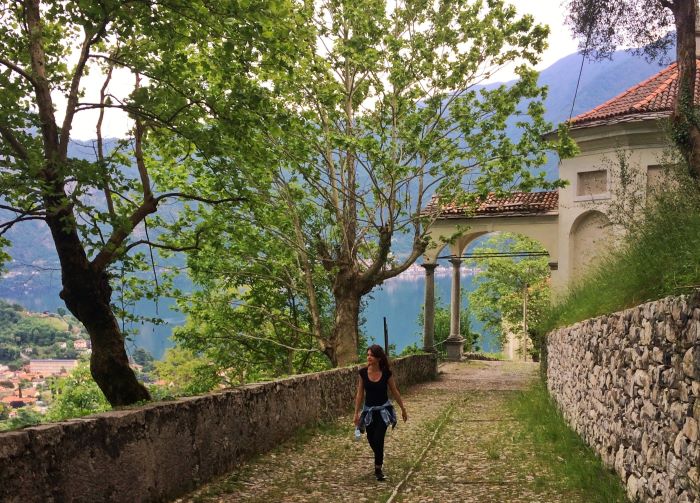
Avenue leading to the shrine
The Sacred Mount of Ossuccio, together with the 14 Rosary Chapels located along the wide avenue leading to the Sanctuary, was declared a UNESCO World Heritage Site in 2003.
Adjectives are wasted here!
Every single chapel is a treasure chest of art, with the 230 life-size statues representing the Mysteries of the Rosary, made by various artists from Como and Ticino. The church then, recently restored, is a veritable ode to the Baroque style, with statues, capitals, marble, stucco and frescoed walls.
The marble statue of the Madonna and Child, on the other hand, is venerated as a dispenser of graces.
Among the people here, the affection for this place is palpable. Some people do not start their day without first making a detour up here, perhaps even just to light a candle.
6# Abbey of St. Benedict
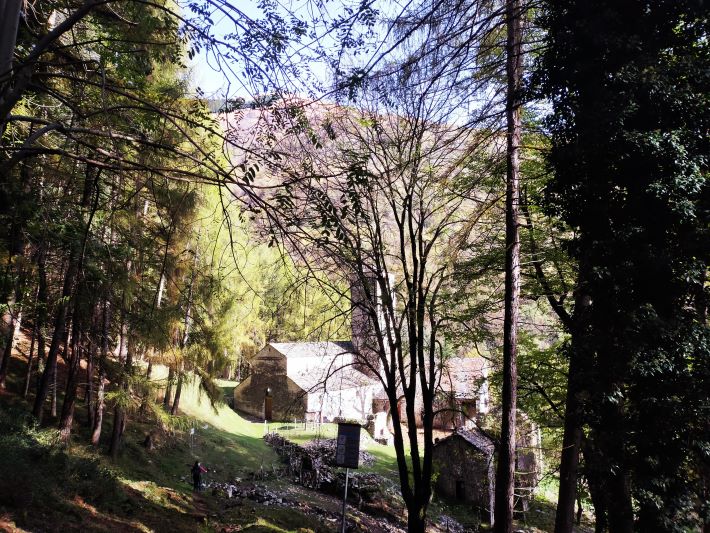
Abbey of St. Benedict
This other gem is just under two hours’ walk from the town, at 800 meters above sea level, and is worth a trip alone!
It is an abbey dating back to the 11th century, part of a Benedictine monastery.
In addition to the beauty of the building, it is worth reaching this place for the peace it can give to those who venture up here.
The walk from Ossuccio is all uphill and for a good part in the woods, and the astonishment one feels when one arrives at the destination is so great: everything is expected except to find, up there in the mountains, such a fascinating architectural and artistic masterpiece.
And even if it is not the love of art that drives you to take this beautiful walk, but simply the desire to immerse yourself in nature, you will be immensely rewarded!
Other goodies to see in and around Ossuccio
Thirty done, let’s make it thirty-one…there are still a few more things to add to the list to complete the portrait of this village.
- The famous Lake Como Greenway also passes through Ossuccio, and knowing this can be helpful in better planning your day and your itinerary
- Ossuccio is also graced by large and renowned villas, such as Villa Balbiano (note, not Balbianello…), Villa della Torre and Villa Leoni. All three are private and therefore cannot be visited, but still visible from the outside. The first two date from the 17th-18th centuries, while the third is none other than the work of architect Pietro Lingeri.
- Ossuccio, like many villages on Lake Como, also has its own tower, called the Barbarossa Tower. Today it is owned by the FAI (the italian National Trust) and can be visited on special days. It can be seen well from the lake and from various points in the village and is still a 15-20 minute walk from the town.
- In September 2024, La Velarca, a houseboat masterpiece of modern architecture built in 1959, was opened to the public. It is moored in front of the Comacina Island and today is also managed by FAI.
I think that’s all.
See you next time!
You might also be interested in the mini-guide: My Lake Como local guide on what to see and do.


0 Comments